Journaling Tips, Strategies & Topics
 |
 |
Listed below you'll find links to various articles and printables on journal writing, where students can keep a continual documentation of their expressions, feelings, and experiences. Journals are also an excellent form of non-traditional assessment. Students can reflect on their thoughts about new concepts without feeling as if they are being tested. |
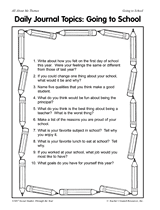
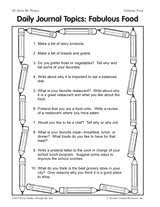
The Concept of JournalingDaily Journal Topics- Daily Journal Topics: Martin Luther King, Jr.
Assign one of 10 journal topics for students on the subject of Dr. Martin Luther King, Jr. This printable provides a great starting-off point for sparking critical thinking about Dr. King, civil rights, and American history. Use it in your Black History Month curriculum (February).
| Observational Journal WritingWriting from Personal ExperienceReading Response Journals- Double-Entry Journals
Use a double-entry journal, a graphic organizer included with this article, to encourage students to organize their thoughts on a specific subject in a new way. New teachers will find this resource particularly valuable.
- Double Entry Journal Template
In the left column of a double entry journal graphic organizer, students write a piece of information, such as a quotation or a concept, which they want to question. In the right column, students relate to or analyze the information that is written in the left column. This printable is customizable. Tailor the PDF to your teaching needs by typing in the highlighted fields before printing.
Journaling in Math- Journaling in Math
Writing about mathematics helps students articulate their thinking, and provides useful information for teachers about learning difficulties, incorrect assumptions, and student's progress in communicating about mathematics.
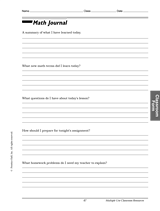
- Math Journal
This form is for students to comment on their performance during daily math lessons. This is a great way for children to monitor their own progress of their math skills. This content is free for a limited time to Special Offers for Teachers subscribers. Not a Special Offers for Teachers subscriber? Visit our Newsletter Center and subscribe today.
- Comparing Fractions with Unlike Numerators Using Journaling
Use a lesson that is an introduction to comparing fractions with like denominators and unlike numerators, for students with a basic understanding of fractions as part of a whole, numerators, and denominators. Students use math journals to complete the lesson.
|
|
TEACHER NEWSLETTERS
Sign up today to receive timely, popular, and free classroom resources!

Asian-Pacific-American Heritage Month
May is Asian-Pacific-American Heritage Month! Don't overlook this opportunity to study and enjoy activities about the history and culture of Asian-Pacific American communities.
Tornadoes in Oklahoma
The recent rash of tornadoes in Oklahoma, which killed at least two dozen people, may have your students wondering why such natural disasters occur, how they may be affected by them, and what they can do to help. Use these resources to teach the geography of Oklahoma and the Southwestern United States, to explain tornadoes, and to discuss the resulting crises with your class.
Top 10 Galleries
Explore our most popular Top 10 galleries, from Top 10 Behavior Management Tips for the Classroom and Top 10 Classroom Organization Tips from Veteran Teachers to Top 10 Free (& Cheap) Rewards for Students and Top 10 Things Every Teacher Needs in the Classroom. We'll help you get organized and prepared for every classroom situation, holiday, and more! Check out all of our galleries today.
May Calendar of Events
May is full of holidays and events that you can incorporate into your standard curriculum. Our Educators' Calendar outlines activities for each event, including: Backyard Games Week (5/23-29) and Memorial Day (5/27). Plus, celebrate Asian-Pacific-American Heritage Month, Clean Air Month, and Physical Fitness & Sports Month all May long!
Common Core Lessons & Resources
Is your school district adopting the Common Core? Work these new standards into your curriculum with our reading, writing, speaking, social studies, and math lessons and activities. Each piece of content incorporates the Common Core State Standards into the activity or lesson.
|