TeacherVision - Lesson Plans, Printables and moreFree Trial  Member Benefits  Sign In    
Click Here
Jun 19, 2013
Search:  
  • Select a Country Please select your location to view
    the most relevant content for you.
1f2n3n
FREE Reference - 1st of 3 Free Items

View 2 more resources at no cost, and then subscribe for full access.

|
 

Types of Snow

Where does snow come from?

Snow crystals are born in the clouds when water vapor freezes on a particle of dust, a floating bit of bacteria, or another solid material.

When cloud temperatures are at the freezing point or below, and there is an ample supply of moisture in the air, ice crystals form around a core particle. As water vapor condenses and freezes, the complex pattern of a snowflake is born, one molecule at a time. A snowflake's hexagonal shape is born at the atomic level. It is here that water molecules bond together into stable crystal structures.

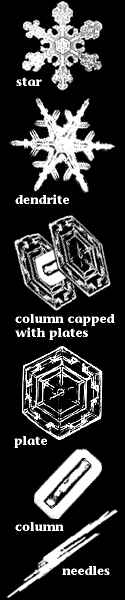
Snow can be further classified into six basic patterns called: Needles, columns, plates, columns capped with plates, dendrites, and stars. Each type is the result of different atmospheric and temperature conditions within the cloud.

While no two snowflakes are alike, they can be generally classified into six basic patterns pictured at the left. Each type of flake is a result of unique atmospheric conditions present at the crystal's birth. Think of them as a kind of "cloud diary" and a record of conditions aloft.

Snow Crystals

Types of SnowflakesStar
Star crystals are born at temperatures near -15 degrees C, and are among the most common type of snowflakes. They are as delicate as they look, and superstars are rare, because large flakes tend to become broken by wind and midair collisions with other crystals. Under ideal conditions several stars my join to form a larger snowflakes. The largest snowflake on record was reported to be a whopping 8" by 12" (about the size of a sheet of typing paper). It was reported to have fallen, probably with a thud, in Bratsk, Siberia in 1971.

Dendrite
Dendrites are stars with attitude. Essentially, they are three dimensional star crystals with branches growing on more than a single plane. Branches (or arms) connect randomly to a central structure. These complex critters form under extremely cold conditions (-20 to -25 degrees C) when high levels of atmospheric moisture are present.

Columns
Columns are produced when the air is dryer. They are generally smaller, have a higher density than star crystals, and form over a wide range of temperatures (15 to -25 degrees C).

Plate
Plates are wanna-be stars that are essentially moisture starved. They form at temperatures of -10 to -20 degrees C when there isn't enough atmospheric water vapor available to form the delicate arms of a classic star.

Column capped with plates
Capped columns are composite flakes formed when the particle of snow passes through different temperature and moisture zones on its journey to the ground. The columns form first, usually at higher and dryer regions of a cloud, and combine with star flakes as they fall through lower and wetter cloud elevations.

Needles
Needles are formed at the upper end of the temperature spectrum, usually when  ground temperatures are at or near the freezing point. To grow, these crystals need an air temperature in the -5 to -10 degrees C range. Needles tend to produce a dense, stiff snow pack which can produce an avalanche under the right conditions.

Did you know?
The greatest North American snow storm in history occurred on Feb. 13–19, 1959 when 15 feet, 8 inches of snow fell in a single snow storm at Mt. Shasta Ski Bowl, Calif. For more snowfall records, see Greatest Snowfalls.

Provided by Family Education.

Highlights

End-of-the-Year Resources
The end of the school year is quickly approaching! Celebrate with fun activities, then prepare yourself and your students with report card advice, summer reading guides, summer math, and more.

Common Core Lessons & Resources
Is your school district adopting the Common Core? Work these new standards into your curriculum with our reading, writing, speaking, social studies, and math lessons and activities. Each piece of content incorporates the Common Core State Standards into the activity or lesson.

Top 10 Galleries
Explore our most popular Top 10 galleries, from Top 10 Behavior Management Tips for the Classroom and Top 10 Classroom Organization Tips from Veteran Teachers to Top 10 Free (& Cheap) Rewards for Students and Top 10 Things Every Teacher Needs in the Classroom. We'll help you get organized and prepared for every classroom situation, holiday, and more! Check out all of our galleries today.

June Calendar of Events
June is full of holidays and events that you can incorporate into your standard curriculum. Our Educators' Calendar outlines activities for each event, including: Summer Begins (6/21), Helen Keller's Birthday (6/27/1880), World War I Began (6/28/1914), and Meteor Day (6/30). Plus, celebrate Child Vision Awareness Month, National Rivers Month, and National Safety Month all June long!

Causes We Support: We Give Books
Visit We Give Books, an ever-growing, free online library of children's picture books! For every book read on the site, a brand-new book will be donated to a children's literacy campaign of your choosing. Read aloud to students or encourage them read independently, and you'll teach them to help others at the same time. Giving is as simple as reading!

Join TeacherVision
for $39.95 a year and start receiving benefits today!
Free 7-Day Trial

TEACHER NEWSLETTERS

Sign up today to receive timely, popular, and free classroom resources!

Free 7-Day Trial for TeacherVision®

Sign up for a free trial and get access
to our huge library of teaching materials!
Start Trial

Teacher Resources | Online Gradebook | Parenting | Reference Site | Homework Help | K-8 Kids | Poptropica
© 2000-2013 Pearson Education, Inc. All Rights Reserved.