TeacherVision - Lesson Plans, Printables and moreFree Trial  Member Benefits  Sign In    
Click Here
May 23, 2013
Search:  
  • Select a Country Please select your location to view
    the most relevant content for you.
History > United States (History) (1222 resources)
1f2n3n
FREE Lesson Plan - 1st of 3 Free Items

View 2 more resources at no cost, and then subscribe for full access.

|
 

Multicultural Statue of Liberty

Grade Levels: 5 - 8

INTRODUCTION
The Statue of Liberty in New York Harbor has greeted more than 17 million immigrants, raising their hopes and dreams as high as she holds her burning torch against the sky. She is an impressive structure and an awesome sight. One hundred two feet tall, the Statue of Liberty stands proudly on a 150-foot pedestal. The torch and flame were the first part of this statue to reach the United States from Paris, France, by way of Philadelphia, PA. The Statue of Liberty herself is, you might say, an immigrant – she is Franco-American! The Statue of Liberty was designed by the French sculptor Frederic Auguste Bartholdi. In his Parisian studio, the artist engaged a female model who helped develop the vision for the great woman that now stands against the famous New York City skyline.

Ideas for Bartholdi's methods of construction were inspired by a 17th-century statue he had seen in Italy. Many renowned hands and minds assisted in raising what is now among the tallest monuments in the world. A project of this size requires collaboration! Gustave Eiffel helped engineer the iron infrastructure (yes, the same Eiffel of the Eiffel Tower). At one point, American sculptor Gutzon Borglum, creator of Mount Rushmore, helped correct the lighting in the flame. Contributions from American newspaper giant Joseph Pulitzer also aided in financing the many-layered project. The Statue of Liberty herself, made of thin copper plates that move like a skin in response to weather and wind, stands firmly for the liberty of all nations.

The Statue of Liberty was a gift from France to the United States to mark the U.S.'s centennial celebration of independence from Great Britain. She is truly international: The seven spikes of her crown represent the seven continents and seven seas of our world. With tablet and torch in hand, she is both strong and flexible – a woman of compassion, conviction, and hope.

"She has come to stand for the common hope of the old world and the new...the peace of mankind – all people living together in justice, mutual respect, and prosperity. This hope has come closest to being realized in America...by free men from many nations," stated American President Dwight D. Eisenhower. This message is as true today as ever. The mighty, colossal, and classical lady in the harbor remains faithful. All are welcome, all are equal: This is the spirit that has made America the diverse and tolerant land known throughout the world for its willingness to embrace these ideals. We have our struggles, but America is still a living, growing nation that continues to strive for liberty and justice for all.

MATERIALS

  • White kraft paper
  • Nontoxic black permanent markers
  • Tempera paint
  • Pencils
  • Colored markers
  • Reproducible page: A Wonderful Way to Display Our Proud Heritage!
  • Glue (optional)
  • Scissors (optional)
  • "Wiggle" eyes and other notions (optional)
  • Acrylic luster/metallic paint (optional)
  • TEACHER PREPARATION
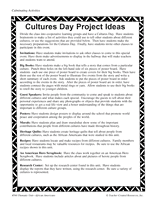
    Do we have some souvenirs, replicas, and books that honor the indomitable Statue of Liberty? You and/or your students may wish to bring objects to class for this cultural heritage lesson. Students should be encouraged to interview their grandparents or "elders" for what they remember about their families' arrival in the United States. If objects are portable (and with household permission secured!) they may be brought to class for storytelling and personal accounts. Objects such as a shawl, a vest, a crocheted handbag, socks, mittens, hair combs – and especially toys – will all help bring the immigrant and settlement experience closer to home. Books that show diverse national world costumes would also be helpful. You may wish to share ideas shown on A Wonderful Way to Display Our Proud Heritage!

    You will want to precut lengths of white kraft paper to "life size" (or approximate size) of the students participating in the lesson. Students may wish to give the new American citizens they will create "a little something" to take with them on their travels as a special gift. Objects that may be held in the statues' hands include fans, photo albums, cassette tapes, toys, or other ideas inspired by actual items. The emphasis of the objects and ideas is on heritage and pride, but be sure they are not so exclusively personal that they can't be exchanged with the class.

    If you wish to use "real-world" details such as toy "wiggle" eyes, trim, lace doilies, and other notions, please have on hand the white glue needed for attaching. Luster or metallic acrylic paint will recall the sterling material presence of our Lady Liberty, to whom this activity is dedicated.

    Note: This project may be a "buddy" project, if desired.

    PROCEDURES
    1) Discuss the amazing structure we know as the Statue of Liberty, and what she represents. Ask students to bring forward any objects they may have garnered from their households. While this lesson focuses on the Ellis Island experience, no one should feel excluded. Realize that the matter of how people came to be Americans is sometimes a sensitive subject, so handle this with care. Also realize that this discussion may require more than the usual introduction time allotted.

    2) Before students begin, have them think about what objects would be carried by immigrants on their way to the "New World." Objects may be personal items or those that represent cultural ideas. Be sure to place precious objects out of harm's way. Distribute paper, pencils, markers, paints, and any other materials to be included in the lesson. Show (or reproduce copies of) A Wonderful Way to Display Our Proud Heritage! in order to generate ideas for objects.

    3) Students will sketch an outline of the Statue of Liberty posture – one arm raised, the other hand holding a tablet or tablet-sized object. The base may be included in the page design. Reinforce what is meant by "life size" and give the meaning of "colossal" or "monument-sized" structures.

    4) Students' pencil drawings should reflect an understanding of proportion, scale, and balance. Garments selected to reflect students' heritage should convey a sense of national origin (Old World). Drawings will include a precious object clutched in one hand, supplied by exchange with a classmate or by students' own personal design.

    5) Apply color either before or after black permanent marker line has been drawn to define the statue of heritage. Add accents or novelty details.

    6) To complete the picture, students may paint the background to represent sky behind the colossal figure (lustrous paint is very effective here) or they can cut the figure away from roll paper for direct mounting.

    7) How many Statues of Liberty can you fit into a display? The more the merrier and the more multicultural – just like America!

    This activity is from Culture Smart.

    Join TeacherVision
    for $39.95 a year and start receiving benefits today!
    Free 7-Day Trial

    TEACHER NEWSLETTERS

    Sign up today to receive timely, popular, and free classroom resources!

    Free 7-Day Trial for TeacherVision®

    Sign up for a free trial and get access to our huge library of teaching materials!
    Start Trial

    Highlights

    Asian-Pacific-American Heritage Month
    May is Asian-Pacific-American Heritage Month! Don't overlook this opportunity to study and enjoy activities about the history and culture of Asian-Pacific American communities.

    Tornadoes in Oklahoma
    The recent rash of tornadoes in Oklahoma, which killed at least two dozen people, may have your students wondering why such natural disasters occur, how they may be affected by them, and what they can do to help. Use these resources to teach the geography of Oklahoma and the Southwestern United States, to explain tornadoes, and to discuss the resulting crises with your class.

    Top 10 Galleries
    Explore our most popular Top 10 galleries, from Top 10 Behavior Management Tips for the Classroom and Top 10 Classroom Organization Tips from Veteran Teachers to Top 10 Free (& Cheap) Rewards for Students and Top 10 Things Every Teacher Needs in the Classroom. We'll help you get organized and prepared for every classroom situation, holiday, and more! Check out all of our galleries today.

    May Calendar of Events
    May is full of holidays and events that you can incorporate into your standard curriculum. Our Educators' Calendar outlines activities for each event, including: Backyard Games Week (5/23-29) and Memorial Day (5/27). Plus, celebrate Asian-Pacific-American Heritage Month, Clean Air Month, and Physical Fitness & Sports Month all May long!

    Common Core Lessons & Resources
    Is your school district adopting the Common Core? Work these new standards into your curriculum with our reading, writing, speaking, social studies, and math lessons and activities. Each piece of content incorporates the Common Core State Standards into the activity or lesson.

    Teacher Resources | Online Gradebook | Parenting | Reference Site | Homework Help | K-8 Kids | Poptropica
    © 2000-2013 Pearson Education, Inc. All Rights Reserved.