
The activities in this section are effective in helping children:
- demonstrate an awareness of music as a part of daily life
- develop kinesthetic pattern recall
- develop spatial awareness
- engage in play with "rules"
- exercise cooperation and social interaction
- gain sequential recall
- learn to interact with and communicate with others
- participate freely in music activities
- respond through movement to music
"The Telephone Rings"
| This song is a playful way for children to sing their names at gatheringtime. This experience also suggests to children that singing is a naturalpart of their lives as they pass the telephone for individual singing. |
Procedures
- Sing the song several times for the children. Then, lead them insinging it as a group until they all know it.
- With the children seated in a circle, pass a toy telephone (whichcan be simply a u-shaped tube) around.
- When each child holds the telephone,it is his or her turn to sing the song, adding the name of the next childat the end.
Click here to listen to this song in MP3 format (254k)
"Ring Around the Rosie"*
| This is a singing game that works for toddlers, preschool, and primaryage children. It is an exercise in sequential recall as well as kinestheticpattern. The children exercise memory and develop a sense of spatial awarenesswith singing game activities. |
- Sing this song with the children either turning in a circle aloneor holding hands in small groups that walk in circle formation as theysing "Ring around the rosie / A pocketful of posies / Ashes, ashesâ¦we allfall down."
- As everyone tumbles to the floor, the teacher quickly begins tappinga beat on the floor and chants the following words to get everyone backon their feet again, "The cows are in the meadow / Eating buttercups /A-tishoo, a-tishoo / We all stand up."
- Use this activity as a circle time activity or on the playgroundor just as a break in the day. It serves the children well as a spontaneousplay activity.
*Traditional song and chant material from the collections of John Feierabend.
"Shoo Fly"
| Singing games are experiences in kinesthetic art. They also engagethe children in activities that develop sequential awareness as well asan understanding of spatial relationships. Singing games are exercisesin movement puzzles. Memory and sequential recall play large roles in thethinking of the children. Cooperation and social interaction dominatesa singing game activity. |
Procedures
- Sing the song with the following action:
- Children pretend to slap the fly off their knees whilesinging the lines, "Shoo Fly! Donât bother me / Shoo Fly! Donâtbother me / Shoo Fly! Donât bother me, for I belong to somebody."
- With partners or alone, have the children turn in a small circle while singing new lines to the tune: "I feel like a morning star / IÂ feel like a morning star / I feel like a morning star, for I belong to somebody."
- Have the children repeat the slapping verse again, then sing andcircle to "I feel like a rainbow rain."
- Repeat the sequence with the words "I feel like a sunshine day"to the verse in which the children circle.
- Encourage the children to begin alone and then to add a partner.
- After the children achieve a comfort level with these stages, increasethe circle size to four and then to eight.
"Pumpkin Patch"
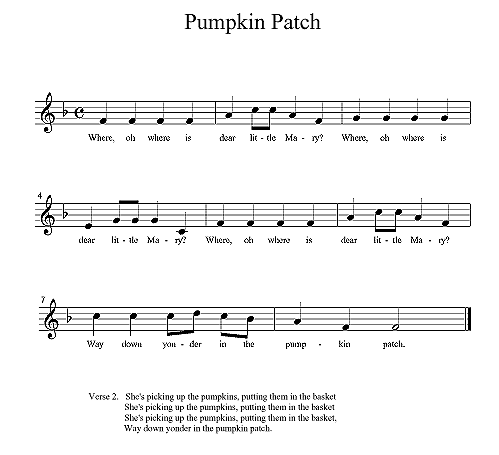
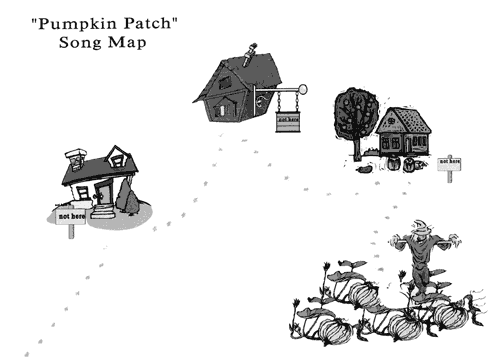
| This experience is based on the familiar folk tune, "Paw Paw Patch."This experience enhances childrenâs development in many areas: in collaboratingwith others in a group, in playing an organized game with "rules," in followinga symbolic representation of sounds, in internalizing a sense of tonalityand rhythm through singing, moving, and representing a song through pictures. |
Procedures
- As the children sit in a circle, sing the song. As you sing thefirst verse, starting "Where, oh where is dear little [name of child],"everyone in the circle looks for the child named.
- As you sing the second verse, "Sheâs picking up the pumpkins, puttingthem in the basket ⦠Way down yonder in the pumpkin patch," that childgoes to the part of the room designated the "pumpkin patch" and picks upimaginary pumpkins one by one.
- Have the children follow the song map as they sing.
- Involve the children in new places that Mary may be visiting, andask them to draw related pictures constructing their own song maps.

| Provided in partnership with NAfME |
Incorporate movement into your music lessons with these fun singing games for "The Telephone Rings", "Ring Around the Rosie", "Shoo Fly", and"Pumpkin Patch".
Subjects


