Mathematics (4008 resources)
1f2n3n

FREE Article - 1st of 3 Free Items

View 2 more resources at no cost, and then subscribe for full access.

Mathematical Dispositions


Page 1 of 3

Mathematical Dispositions

One strategy for in-service or pre-service teachers to get into a more mathematical frame of mind and actually enjoy some interesting aspects of mathematics is to engage in games and other activities based on mathematical concepts. These are also great for beginning the school year with students. Figures 1.1 through 1.5 illustrate different types of activities including puzzles, number patterns, everyday math, and dominoes. Other activities can be found in mathematics journals, professional books, and on teacher websites.

What teacher dispositions are critical for promoting student learning of mathematics? Some are certainly global, important for all teachers: a keen personal interest in learning and growing; reflective teaching; a view that all students can learn but each student is an individual learner; high but realistic expectations of learners; flexibility in adapting instruction, materials, and assessment to varying contexts; and the ability to create a positive yet goal-oriented classroom environment. Some dispositions are more specific to mathematics content: genuine interest in mathematical concepts and connections; a persistence with finding solutions to problems; the willingness to consider multiple processes or multiple solutions to the same problem; and an appreciation for mathematics-related applications such as those in music, art, architecture, geography, demographics, or technology.

Figure 1.1
Picture Puzzles

1. How many 2 by 1 by 1 blocks (length by width by height) make up this structure if at least one face of each block is visible? How many 1 by 1 by 1 blocks would be required to make the same structure?
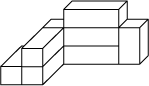
box structure

2. Here is a pattern for making a cube (three-dimensional shape with six squares for sides – such as a die). The thin "tabs" are to be folded for gluing. Using a piece of graph paper, design another pattern for a cube. Or try another shape, like a pyramid or tetrahedron.
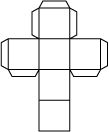
box structure

Figure 1.2
Fun with Fibonacci Numbers

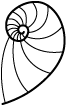
Fibonacci numbers are numbers of the following sequence: 1, 1, 2, 3, 5, 8, 13, 21 ... where successive numbers are the sum of the two preceding numbers. This sequence of numbers or patterns formed by this sequence appears naturally in the environment. Find a leaf, stem, pinecone, or seashell with the spiral pattern shown here. Look for this pattern elsewhere in nature or art.

Draw your own spiral on a piece of graph paper following these direction.

  1. Select one square near the center and trace it.
  2. Trace in one square to the right.
  3. Trace in on square that is 2 block by 2 blocks (2 x 2) above the two previous squares.
  4. Trace in a square that is 3 by 3 to the left.
  5. Trace in a square below that is 5 by 5.
  6. To the right, trace in a square 8 by 8.
  7. Above, trace in a square 13 by 13.
  8. Continue as long as you have room on the paper.
  9. Beginning in the first square, connect the corners of each square in the same sequence with a looping spiral, like that of a nautilus shell.

That spiral is a Fibonacci pattern!

sprial shell

Figure 1.3
Other Number Patterns

1. Predict the number that would come next. What is each pattern?

  • 2, 3, 5, 7, 11, 13, 17, 19, ____, ____
  • 1, 4, 9, 16, 25, ____, ____
  • 1, 3, 4, 7, 11, 18, ____, ____

Using a hundreds chart (1 to 100), explore the concepts of multiples and factors (prime and composite numbers):

  • Circle 2 and strike through all multiples of 2.
  • Circle 3 and strike through all multiples of 3.
  • Continue with 5, 7, 11, 13, 17.
  • (The number 1 is neither prime nor composite.)
  • Circle all numbers not crossed out. these are prime numbers and don't have factors other than one and themselves. this process is called the "Sieve of Erathsthenes" after the Greek mathematician (275–195 B.C.E.) given credit for this simple method for identifying prime numbers (Wolfram, 2002).

Figure 1.4
Math All around Us

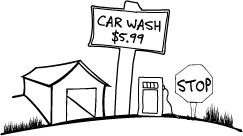
1. Take a walk around your neighborhood and make a list of all the mathematics application you spot.

Car wash sign

2. Look through a newspaper and make a list of all the math applications (obvious and hidden). Some examples of obvious application: weather charts, stock market, sports statistics, grocery sales. Hidden applications: probability of events, statistics within an article, graphs, reports on science and technology.

Newspaper

Figure 1.5
Dominoes: A Common Game with Powerful Math Concepts

Obtain a set of 28 dominoes, or print and cut out a set. Study the dot patterns and count up the groupings. The pieces are sometimes called bones, the dots are called pips. Any group of bones with a common end is called a suit, and bones with identical ends are called doublets.
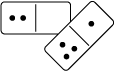
Dominoes

Make up a game for two players or follow the rules below for a simple game. (More complex rules can be found online or in a book on dominoes.)

  • Place all pieces facedown and shuffle them around.
  • Draw for the lead by selecting the piece with the highest number and reshuffle. Each placyer then draw seven bones.
  • The lead player usually plays his highest domino first. The object of this game is to have the fewest pips left in hand.
  • The second player must play a piece that matches one end of a piece on the table. Coublets are played crosswise. Players who cannot make a match must draw another bone.
  • The player who matches all bones in his hand calls "Domino" and earns the number of points as there are pips in his opponent's hand.


 Previous  1  2   3   Next 

Math Instruction for Students with Learning Problems, by Susan P. Gurganus, is a field-tested and research-based approach to mathematics instruction for students with learning problems. It is designed to build the confidence and competence of pre-service and in-service teachers (Pre-K-12). Field-testing over a three-year period showed the approaches in this text resulted in significantly improved teacher candidate attitudes about mathematics, increased mathematics content understanding, and professional-level skills in mathematics assessment and instruction.

Highlights

November Events

Find educational resources for every day in November. Fill your November lessons with activities for Thanksgiving (Nov. 27).

Math Printables

Browse our most popular math resources in our Printable Rulers & Protractors Slideshow and Number Lines & Place-Value Charts Slideshow.

New Resources

Not only have we added new printable books for Maps & Activities and The Human Body, but we've also focused on new classroom management resources. Try our Homework Excuse Form, Quieting the Class Quickly, Handling Misbehavior During Instruction, and Checking Student Progress in Homework. Take a look at all the new pages added to TeacherVision.

Walden Forums

Wondering about online education at Walden? Get answers to your questions, meet faculty, and learn what it's like to be a Walden student. Click here to check out our free Walden Forums!

2009 Educators' Calendar

There's something worth celebrating every day! Find fun and educationally relevant holidays, events, and celebrations for each day of the year.

Printable Maps

Enrich your lessons with our collection of printable world maps depicting continents, countries, capitals, political boundaries, lines of longitude and latitude, climate zones, oceans, land forms, and more. Plus, browse our collection of Unites States maps.

Daily Printables

Add a TeacherVision widget to your blog, personalized homepage (such as iGoogle or Pageflakes), or social networking sites (such as Facebook). Our widgets feature a different fifth-grade language arts printable or fourth-grade math printable for each day of the year.

Discussion Guide: The Mayflower and the Pilgrims' New World

The teacher's guide for The Mayflower and the Pilgrims' New World, from Penguin Young Readers, is filled with discussion questions, research assignments, and writing activities to engage your students in early American history. Enjoy this book with your students around Thanksgiving or when introducing them to the Colonial Period and Native American History.


Join TeacherVision
for $39.95 a year and start receiving benefits today!
Free 7-Day Trial