
An article discussing the voyages of Christopher Columbus and what he really discovered.
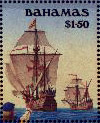 |
After landing on a small island on Oct. 12, 1492, in what he believed were the Indies, Columbus sailed along the coast of Cuba, certain that he had finally reached the continent of Cathay. He searched in vain for the magnificent cities Marco Polo had described, hoping to deliver a letter from the Spanish monarchs to "the great Khan," the Chinese emperor. "Afterwards," Columbus wrote on Oct. 21, "I shall set sail for another very large island which I believe to be Cipango, according to the indications I receive from the Indians on board." Columbus's Japan proved to be the island of Hispaniola.
Refusing to Ask for DirectionsThree voyages later, Columbus still resolutely maintained that he had reached Asia despite growing contrary evidence. Amerigo Vespucci's 150l voyage along the coast of South America convinced most explorers and their patrons that a huge unexplored continent existed across the Atlantic—what Vespucci called Mundus Novus, the New World. Columbus, however, died in 1506 still insisting that he had found a new route to Asia.
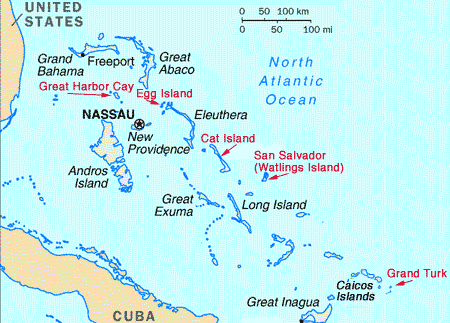 Columbus's arrival point in the New World is still contested. |
Where in the New World is San Salvador?
But confusion over where Columbus landed in the New World has not been restricted to the explorer himself. For centuries scholars have hotly debated where Columbus first set foot in the Western Hemisphere—the so-called landfall controversy. All have agreed that Columbus arrived on an island in the Bahamas that he named San Salvador (Holy Savior), and that the island's Arawak inhabitants called Guanahani. But dozens of different islands have been bandied about by numerous historians as the genuine San Salvador. The three most popular contestants have been Watling's Island (called San Salvador today), Cat Island, and Grand Turk (which today is no longer part of the Bahamas).
Guanahani/Watlings/San SalvadorMore than 500 years later, there still is no definitive answer to the landfall question, but the general consensus is that Columbus landed on what was known until 1926 as Watlings Island. The island was named for a local pirate famous for his piety—marauding and pillaging was strictly forbidden on Sundays. The residents of Watlings renamed their island San Salvador in 1926, figuring the right name was key to their claim as Columbus's island.
The 400th CentennialAmong the early historians involved in the landfall controversy was Washington Irving, whose volume, Life and Voyages of Christopher Columbus (1828), suggested that the explorer first landed on Cat Island, to the northeast of Watlings. As the 400th anniversary of Columbus's arrival in the New World drew near, a special investigation of various Bahamian islands was commissioned, meant to clear up the controversy once and for all. The report, however, just emphasized how muddled the controversy had become:
…No two investigators agree as to the first landfall without disagreeing as to the second; and if they happen to coincide on the first, it is only to fall out over the fourth.Not Just Another Pretty Island
—Frederick A. Ober, In the Wake of Columbus (1893)
The difficulty in pinpointing Columbus's first landing is in part the result of the sketchy information provided in his captain's log. The island is described as large, level, and with a lagoon, and like all the other islands he encounters, "these lands are the most fertile, temperate, level and beautiful countries in the world." With so little to go on, it is easy to make an argument for nearly any beautiful lagoon in the Bahamas.
Another difficulty is the lack of archeological evidence. Columbus landed only briefly on the island—he was far more interested in moving on to richer and more promising parts of the Indies. No definitive trace of his presence has been uncovered. And although a number of early maps show the island of Guanahani, the island is found in various locations depending on the vagaries of the cartographer.
More Centennial SquabblingIn 1986, the landfall controversy again grew tempestuous. As the 500th Columbus centennial approached, National Geographic presented a sophisticated argument claiming that Samana Cay was the true island of Columbus's landing. This stirred up the waters, but most historians, including such luminaries as Samuel Eliot Morison, maintained that Watlings/San Salvador was the true landfall.
Columbus Slept HereWhich is a perfectly agreeable conclusion according to San Salvador's 539 inhabitants, who depend on Columbus-inspired tourism for their livelihood. The present-day San Salvadorans are the descendents of freed slaves—the original inhabitants, the Arawaks, have long since vanished. The island boasts "Discovery Bay," where Columbus allegedly made his first landing, the "Three Ships" restaurant—and a Club Med for sybaritic history buffs.
| The Voyages | |
| First Voyage, 1492-1493 San Salvador, The Bahamas Cuba Hispaniola Second Voyage, 1493-1494 Dominica Hispaniola Guadeloupe Antigua Puerto Rico Cuba Jamaica Third Expedition, 1498-1500 St. Vincent Grenada Trinidad Margarita Venezuela Fourth Expedition, 1502-1504 St. Lucia Martinique Honduras Nicaragua Costa Rica Panama |


