
 |
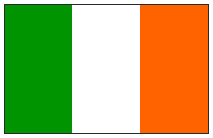
Rarely has a flag possessed such lasting relevance as that of the "Tricolour," the national flag of the Republic of Ireland. Its three equal stripes illustrate the Irish political landscape as accurately today as in 1848, the year the flag was first unfurled.
ORANGE standing for Northern Irish Protestants
GREEN signifying Irish Catholics and the republican cause
WHITE representing the hope for peace between them
The color orange is associated with Northern Irish Protestants because of William of Orange, the King of England who in 1690 defeated the deposed King James II, a Roman Catholic, in the fateful Battle of the Boyne near Dublin. William III's victory secured Protestant dominance over the island, to the enormous benefit of the 17th-century colonizers of northern Ireland-the English (mainly Anglicans) and Scots (mostly Presbyterians). Sometimes called Orangemen, Protestants in Northern Ireland celebrate the anniversary of the battle each July 12th.
Green for the Emerald Isle?The Symbolism Isn't as Obvious as You Think
Green as the color standing for the Irish Catholic nationalists of the south may have something to do with shamrocks and verdant landscapes, but more importantly, green symbolizes revolution. An earlier, unofficial Irish flag--the gold harp on a green background-served from 1798 until the early twentieth century as a symbol of nationalism. As the revolutionary James Connolly wrote, just weeks before he participated in the quixotic Easter Rebellion (1916) that led to his execution by firing squad:
For centuries the green flag of Ireland was a thing accurst and hated by the English garrison in Ireland, as it is still in their inmost hearts. . . .A Lasting Truce between Orange and Green?
. . . the green flag of Ireland will be solemnly hoisted over Liberty Hall as a symbol of our faith in freedom, and as a token to all the world that the working class of Dublin stands for the cause of Ireland, and the cause of Ireland is the cause of a separate and distinct nationality.
Worker's Republic, April 8, 1916
Although it was not adopted as the national flag of Ireland until independence from Britain on December 6, 1921, the Tricolour was first unfurled in public on March 7, 1848, by the militant nationalist Thomas Francis Meagher,* (the stripes, however, were arranged differently at that time). Explaining the significance Tricolour, Meagher expressed a hope for his country that is unfortunately still unrealized today:
The white in the center signifies a lasting truce between the "Orange" and the "Green," and I trust that beneath its folds the hands of the Irish Protestant and the Irish Catholic may be clasped in generous and heroic brotherhood.
*Irish revolutionary was just one of Meagher's careers: he was also a prisoner in a Tasmanian penal colony, a New York City lawyer, and a Civil War general for the Union Army.


