
 |
Hanukkah is a relatively minor holiday in the Jewish year. In the United States, however, its closeness to Christmas has brought greater attention to Hanukkah and its gift-giving tradition. Amid the ever-growing flood of Christmas, it may seem especially fitting that the Hanukkah story tells of Jewish culture surviving in a non-Jewish world.
The Hanukkah Story
Nearly 2,200 years ago, the Greek-Syrian ruler Antiochus IV tried to force Greek culture upon peoples in his territory. Jews in Judea – now Israel – were forbidden their most important religious practices as well as study of the Torah. Although vastly outnumbered, religious Jews in the region took up arms to protect their community and their religion. Led by Mattathias the Hasmonean, and later his son Judah the Maccabee, the rebel armies became known as the Maccabees.
After three years of fighting, in the year 3597, or about 165 B.C.E., the Maccabees victoriously reclaimed the temple on Jerusalem's Mount Moriah. Next they prepared the temple for rededication – in Hebrew, Hanukkah means "dedication." In the temple they found only enough purified oil to kindle the temple light for a single day. But miraculously, the light continued to burn for eight days.
The Menorah
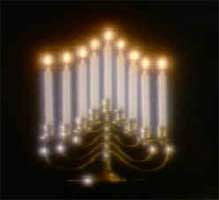
The lighting of the menorah, known in Hebrew as the hanukiya, is the most important Hanukkah tradition. A menorah is a candlestand with nine branches. Usually eight candles – one for each day of Hanukkah – are of the same height, with a taller one in the middle, the shamash ("servant"), which is used to light the others. Each evening of Hanukkah, one more candle is lit, with a special blessing.
The menorah symbolizes the burning light in the temple, as well as marking the eight days of the Hanukkah festival. Some say it also celebrates the light of freedom won by the Maccabees for the Jewish people.
The Dreidel
Long a favorite Hanukkah toy, the dreidel once had a serious purpose. When the Syrians forbid study of the Torah, Jews who studied in secret kept spinning tops – sivivons, or dreidels – on hand. This way, if they were found studying, they could quickly pretend that they had only been playing.
Outside of Israel, a dreidel has the Hebrew letters "nun," "gimel," "hay," and "shin" on its four sides. These letters stand for "Nes gadol haya sham," which means, "A great miracle happened there," referring to Israel. An Israeli dreidel has the letter "pay" rather than "shin." This stands for "poh," meaning "here" – "a great miracle happened here."
The Hebrew letters also represent Yiddish words that tell how to play the dreidel game. Each player starts with the same amount of candies, chocolate coins (gelt), or other tokens, and puts one in a pot. Players take turns spinning the dreidel, waiting to see which letter lands face up. Nun is for "nisht," nothing – do nothing. Gimel is for "gants," whole – take the whole pot. Hay is for "halb," half – take half. Shin is for "shtel," to put in – add to the pot. The game ends when a single player wins all the tokens.
Hanukkah Foods
Many traditional Hanukkah foods are cooked in oil, in remembrance of the oil that burned in the temple. In the United States, the most widespread Hanukkah food is latkes, or potato pancakes, a custom that may have developed in Eastern Europe. In Israel, the favorite Hanukkah food is sufganiya, a kind of jelly donut cooked in oil. Israelis eat sufganiyot for more than a month before the start of Hanukkah.
Eating dairy products, especially cheese, is another Hanukkah tradition. This is done in memory of the Jewish heroine Judith, who according to legend saved her village from Syrian attackers. Judith fed wine and cheese to the Syrian general Holofernes until he became so drunk that he fell to the ground. She then seized his sword and cut off his head, which she brought back to her village in a basket. The next morning, Syrian troops found the headless body of their leader and fled in terror.


