
The 2012 Republican presidential nominee falls to Obama in the general election
by Liz Olson and Jennie Wood
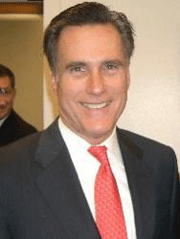
After a bruising general election campaign that largely focused on the economy and women's rights, Mitt Romney lost his presidential bid to the Democratic incumbent, Barack Obama. On Nov. 6, 2012, Romney finished the race for 45th U.S. president with 206 electoral votes to Obama's 303. Obama prevailed in battleground states that were must-wins for Romney, including Ohio and Virginia.
In the early fall following the nominating conventions, Obama was considered a shoo-in, but Romney gained momentum after the first presidential debate in which he came out fighting and President Obama gave a surprisingly lackluster performance. In addition, during the general election campaign Romney moderated his far-right stance on several key issues, such as abortion, taxes, and immigration, seemingly to appeal to the centrist wing of the party. Throughout October, the race was neck-and-neck, and many analysts predicted that the results may not be final for days. However, Obama's win in several key battleground states tipped the race in his favor, and Romney delivered his concession speech shortly before 1 a.m. on Nov. 7.
"This is a time of great challenges for America, and I pray that the president will be successful in guiding our nation," he said. "The nation, as you know, is at a critical point. At a time like this, we can't risk partisan bickering and political posturing. Our leaders have to reach across the aisle to do the people's work. And we citizens also have to rise to the occasion."
Romney Learns from 2008
Mitt Romney may have lacked the political experience of his rivals when he ran for the Republican presidential nomination in 2008, but four years later he has emerged as the seasoned front runner, comfortable in front of a crowd, and unafraid to discuss controversial issues, such as the similarity between his successful Massachusetts health care plan and Obama's national one. His success in business and managing the 2002 Olympic Games has demonstrated an innate leadership ability and attracts voters worried about the country's troubled economy.
Romney’s presidential campaign agenda is based on conservative principles, including small government, lower taxes, national security, defending the traditional family, and calling out Obama for being ineffective, especially when it comes to the economy.
Born into a politically active family in Detroit, Michigan, with roots in the Mormon Church, it was only natural that Romney would pursue a political career. His father, George W. Romney, was the governor of Michigan from 1963-69, and a 1968 presidential candidate. His mother, Lenore Romney, was a U.S. Senate candidate in 1970.
Business Career
Romney graduated with a B.A. from Brigham Young University, and then earned an M.B.A. and a J.D. from Harvard Business and Law schools. After graduating from Harvard, Romney began his business career with the Boston Consulting Group in 1974, and went on to become vice president of another Boston-based consulting firm, Bain & Company, Inc. In 1984, he co-founded Bain Capital, a private equity investment firm. He headed the company for 14 years, investing in or buying well-known companies such as Staples, Brookstone, Domino’s, and Sports Authority. He and his wife have accrued a net worth of between $190 and $250 million.
With a short political résumé, Romney draws on his business experience and his role on the 2002 Olympic Games committee as proof of his ability to run the nation. Romney was brought in as the president and CEO of the 2002 Salt Lake City Olympic Games in 1999 to rescue the games from fiscal crisis. He overhauled the committee’s leadership and policies, reduced budgets, and increased fundraising. He also coordinated a $300 million security budget to ensure safety at the Games in the wake of the September 11, 2001, attacks.
Massachusetts Politics
Romney’s political career has been brief; he served as the governor of Massachusetts for only one term. In 1994 he lost to Democrat Ted Kennedy in the race for the U.S. Senate. Kennedy, however, won by the slimmest margin in his nine terms in the Senate.
Despite a complaint filed by the Democratic Party about residency issues, Romney ran for governor of Massachusetts in 2002. He used $6.3 million of his own money during the campaign, and defeated Democrat Shannon O’Brien in the general election.
As governor, Romney created a scholarship program that rewards the top 25% of Massachusetts high school students with a tuition-free education to any Massachusetts public college or university. He also proposed and signed legislation that requires all Massachusetts residents to have health care.
Romney’s early support gave way to criticism over the explosive gay marriage issue in Massachusetts. He opposes same-sex marriages and civil unions, yet he backed a proposed state constitutional amendment in 2004 that would have allowed civil unions and banned gay marriage (the amendment failed to pass). He withdrew his support of this amendment, however, in favor of a 2005 petition that banned both. (In 2003, the Massachusetts Supreme Judicial Court ruled that barring gays and lesbians from marrying violates the state constitution.)
2008 Campaign for President
After his term as Massachusetts governor ended in January 2007, Romney formally announced his candidacy for the Republican presidential nomination. While Romney was certainly not the first politician from Massachusetts to run for president, he did break the mold of Massachusetts liberal. His campaign was aimed at the conservative wing of the Republican Party. Regardless of his short political career, Romney’s business acumen translated into success in fund-raising, which allowed him to be one of the top contenders for the Republican nomination.
On December 6, 2007, Romney gave a 20-minute speech at the George Bush Presidential Library in Texas to address concerns expressed by many voters about his faith. "I believe in my Mormon faith and endeavor to live by it," said Romney, but he also stressed that his religious views would not affect his ability to be president. Romney was doing well in early voting states, so it was argued he did not need to give a speech about his religion. However, it had been a sensitive issue since he began running for the Republican nomination, and his support began to shift in states like Iowa. Polls showed that Americans would not vote for a Mormon candidate. According to evangelical Christians, who make up a significant amount of Republican votes, Mormonism is heretical.
Many people compared Romney's speech to one made by John F. Kennedy in 1960 about his Roman Catholic faith. Kennedy was trying to convince ministers, who were openly hostile of his faith, that his religion would not affect his governance. Romney, on the other hand, spoke in front of a friendly crowd. In his speech, Romney advocated for religion to take a larger role in American public life. Romney stated that "no candidate should become the spokesman for his faith. For if he becomes president he will need the prayers of the people of all faiths."
Another reason for Romney's "Faith in America" speech was the rise in the polls of Southern Baptist minister and former Governor of Arkansas, Mike Huckabee. Huckabee ran a Christian-themed campaign and, on January 3, 2008, won the Iowa Republican Caucuses, the first contest of the primary season, with 34 percent of the vote. Romney placed second with 25 percent of the vote even though he outspent Huckabee. Both John McCain and Huckabee began attacking Romney for being a flip flopper on issues. Romney stayed in the race through Super Tuesday. On February 7, just two days later, he announced the end of his campaign. At that time McCain was leading Romney in delegates by a margin of more than two-to-one. A week later, Romney endorsed McCain for president.
2012 Campaign for President
On April 11, 2011, Romney announced that he had formed a committee to explore a run for the Republican presidential nomination. In the announcement he said, "It is time that we put America back on a course of greatness, with a growing economy, good jobs, and fiscal discipline in Washington." Romney emerged as the early front-runner in a weak field. Many potential candidates declined to run, including Mike Huckabee, Donald Trump, and Mitch Daniels. Romney's greatest hurdle this time out was the Massachusetts health care reform law that he signed as Governor because it closely resembles Obama's national health care law, which republicans were working to overturn.
In August 2012, Romney introduced Wisconsin Representative Paul D. Ryan as his presidential running mate during an appearance in Norfolk, Virginia. The announcement immediately energized Romney's campaign, which raised $1.2 million dollars in just four hours after the announcement. Later that month, during the Republican National Convention in Tampa, Florida, Mitt Romney was officially nominated by the Republican Party. At the convention his wife, Ann Romney, gave a speech, assuring voters that they could trust her husband. "This man will not fail. This man will not let us down. This man will lift up America," she said.
 Learn more about the 2012 Presidential Election.


