Earthquake in China, May 2008
![]() |
The tragedy of the May 2008 earthquake in China may have your students wondering why such large catastrophes occur and how they might be affected by natural disasters. These resources will help you explain earthquakes and the resulting crises to your class. We have reference materials that explain the different causes of earthquakes, information on where earthquakes generally occur, and ways in which you and your class can help those affected by the destruction caused by the recent disaster in China. |
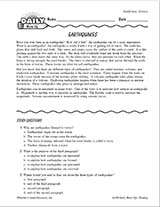
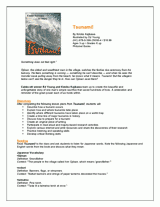
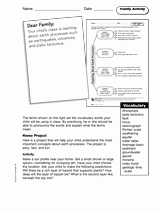
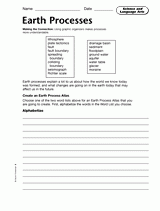
General ReferencesExplore connections in mathematics and nature with this article on earthquakes. This quiz will assess knowledge of earthquakes. Through this activity students will learn that earthquakes and volcanoes occur where the earth's plates collide (lesson plan and background information included). The San Francisco earthquake of 1906 had far-reaching effects. Read about it and then explore the related activities. Activities & WorksheetsStudents draw before and after pictures of the scene of an earthquake. This worksheet teaches students about the various ways that we can measure and predict earthquakes. Seismographs are discussed. Students are then asked to respond to the reading on an included worksheet. Teach your students about earthquakes while improving their reading comprehension skills. This printable warm-up includes a science reading passage and related questions. Suggest a family activity to parents that focuses on Earth processes such as earthquakes, volcanoes, and plate tectonics, and on vocabulary words related to Earth. Students draw from a list of words, including such words as lithosphere and plate tectonics, to make a picture atlas of the earth's geologic history. Students create a model to show the effects of strike-slip, normal, and reverse faults on a surface feature, such as a river, road, or fence. Assesses their understanding of the different types of stress that occur in Earth's crust, and the different kinds of faults these stresses cause. Scoring rubric and background notes included. In this activity, students create model buildings from toothpicks. Using Jell-O, sand, and modeling clay, they then simulate earthquake activity to test the stability of their structures. Students create a model for each of three types of plate boundaries: transform boundary, divergent boundary, and convergent boundary. Assesses their understanding of plate tectonics and plate boundaries. Scoring rubric and background notes included. Students develop a working model of plate divergence at the mid-ocean ridge and plate convergence at a trench. Assesses their understanding of the processes of sea-floor spreading, plate divergence, and plate convergence, which shape the ocean floor. Scoring rubric and background notes included. Use this worksheet to help students read map keys. Safety Preparation MaterialsThe best way to handle a disaster is to be prepared, as students learn in this printable. Students answer questions about earthquake preparations and safety. They also learn about earthquakes in the developing world. Distribute a reading selection and an assignment on earthquake science, predictions, and safety. | Teaching Disasters & CrisesA cause and effect analysis is an attempt to understand why things happen as they do. Use this resource to help your students understand the effects of various events and actions, so they have a better grasp on the way the world operates. Peruse an article that is intended for parents, but has useful advice for teachers. It details, by age levels, how to explain horrific events to children. How to prepare your exceptional students during disasters both on school campuses and in their respective communities. How to prepare yourself and your class for disasters. An age breakdown of the development of children understanding death. Maps of AsiaShow your students where China is located on one of these maps. Chinese CultureCombine painting, poetry, and calligraphy to create Chinese scrolls. This is a fun and educational art activity for the Chinese New Year. Teach children about Chinese culture by baking traditional mooncake cookies. Follow these steps to create three-dimensional paper sculptures of dragons for the Chinese New Year. Learn about the things we use in everyday life that were invented in China. Check your answers here. Teach children about the different ways in which the Chinese use insects with a printable sheet. Charities Providing Aid to Earthquake VictimsIf you're students are interested in collecting money to donate to victims, or if you just want to help, these charities have specific funds dedicated to helping those affected by the 2008 China Earthquake. These groups are approved as four-star organizations by Charity Navigator, an independent business that evaluates charities to ensure your money is used as intended. Other Natural DisastersBe prepared for future wide-scale natural disasters with lessons and materials on volcanoes, floods, hurricanes, tsunamis, and tornadoes. |
Walden University
Wondering about online education at Walden? Get answers to your questions, meet faculty, and learn what it's like to be a Walden student. Click here to check out our free Walden Forums!
November Calendar of Events
Use our Educators' Calendar to find activities and printables for every day in November, including Geography Awareness Week (Nov. 15–21) and Thanksgiving (Nov. 26). Plus celebrate American Indian Heritage Month and Aviation History Month all November long!
Continuity of Learning
Is the flu causing you or your students to miss class? Pearson introduces www.PearsonContinuity.com to help keep the doors of learning open. This new website offers print and online resources for students, parents, and teachers to continue education if the H1N1 virus or another crisis keeps children from attending school.
Teaching The Diary of Anne Frank
PBS MASTERPIECE is airing a new film in the spring based on The Diary of Anne Frank, and, in conjunction with Facing History and Ourselves, the MASTERPIECE team will be creating resources to help educators introduce this timeless story to students. You're invited to share your ideas about what activities and tools you'd like to use in your classroom at the PBS Teachers blog!
Bulletin Boards
Improve effectiveness and enjoyment of lessons with our bulletin board ideas and examples. They'll make your classroom visually appealing and stimulating for your students.
Top-Ranked Educational Program—100% Online
Equip your faculty with today's best practices through an MS in Curriculum and Instruction or an MS in Educational Administration—100% online from The University of Scranton. Find out more!