Science > Biology > Zoology > Animals (817 resources)
1f2n3n

FREE Reference - 1st of 3 Free Items

View 2 more resources at no cost, and then subscribe for full access.

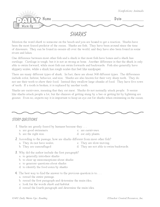
Some Unusual Facts About Snakes

"Snake" is an ancient word and comes from the Indo-European base sneg, meaning "to creep"; it is also related to the word "snail," which has the same root.
  1. How long do snakes live? We can't know for certain, but snakes in zoos have long lives. One boa constrictor has lived 27 years in a zoo, and a South American anaconda is still going strong after 28 years!
  2. How big do snakes get? They can be very tiny or very large, depending on the kind. The ground snake is about 5 inches long while a python can grow to be 30 feet in length and weigh 200 pounds.
  3. How often does a snake eat? Snakes eat only when they are hungry. This can be once every 3-4 days or the interval may be even longer – weeks or months. Zoo snakes, because they don't move much, may eat just one or two times a year!
  4. Do all snakes lay eggs to reproduce? No, some snakes give birth to tiny living snakes that crawl off and take care of themselves right from the start.
  5. What snake is the best mother? No snake mothers her babies the way humans do, but the python mother makes a nest and coils up on her eggs to keep them safe until they hatch.
  6. How does a snake keep clean? Its scales are very smooth and fit together so there is no place for dirt to catch on a snakeskin. Also, snakes get brand-new skins every once in a while so they are usually very, very clean.
  7. How many kinds of snakes are there? There are about 2,600 different kinds of snakes. Of these, about 400 are poisonous.
  8. How many different kinds of snakes live in the U.S.? There are 126 different kinds of snakes in the United States. Only 19 are harmful to people.
  9. Why is it true that snakes are good for the world? Snakes are very helpful. The small ones eat harmful bugs and insects. The big ones eat rats, mice, gophers, and animals that destroy crops. Good farmers and gardeners know how helpful most snakes are and are happy to have them around. All snakes except those that threaten people should be kept safe from harm. They are part of the chain of living things – as we are!

Excerpted from The Complete Teacher's Almanack.


Join TeacherVision
for $39.95 a year and start receiving benefits today!
Free 7-Day Trial

Highlights

December Events

Find educational resources for every day in December. Fill your December lessons with activities for Hanukkah (Dec. 21 -- Sundown), Winter Solstice (Dec. 21), Christmas (Dec. 25), Kwanzaa (Dec. 26), New Year's Eve (Dec. 31), Universal Human Rights Month (Dec.), World AIDS Month (Dec.).

Rulers & Number Lines

Take a look at our collection of printable rulers and protractors and number lines and place-value charts.

Letter-Writing Activities

Develop students' composition skills with these printables and activities. Students will learn about basic letter formats and practice writing formal, persuasive, and friendly letters.

Walden Forums

Wondering about online education at Walden? Get answers to your questions, meet faculty, and learn what it's like to be a Walden student. Click here to check out our free Walden Forums!

2009 Educators' Calendar

There's something worth celebrating every day! Find fun and educationally relevant holidays, events, and celebrations for each day of the year.

Printable Maps

Enrich your lessons with our collection of printable world maps depicting continents, countries, capitals, political boundaries, lines of longitude and latitude, climate zones, oceans, land forms, and more. Plus, browse our collection of Unites States maps.

Daily Printables

Add a TeacherVision widget to your blog, personalized homepage (such as iGoogle or Pageflakes), or social networking sites (such as Facebook). Our widgets feature a different fifth-grade language arts printable or fourth-grade math printable for each day of the year.