
by Michael Morrison and Chris Frantz
Icing the Stereotypes
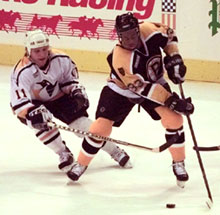
When Anson Carter was ten years old, his life was much the same as most of the other boys growing up in his Scarborough, Ontario, neighborhood. He went to school, came home, and played hockey. As he continued to play, advancing rapidly through his local leagues and on to Michigan State University, he began to stand out for two reasons. One, he was almost always the best player on the ice, and two, he was black—a rarity in hockey.
Carter was the second-leading scorer for the Boston Bruins in 1999–2000, was traded to the Edmonton Oilers in 2000, to the New York Rangers in 2002, and went to the Vancouver Canucks in 2005. He was one of 17 black athletes in the NHL in 2004. It's a number that may seem low (given the 600+ players in the NHL today) but it still represents a noticeable increase in what has always been thought of as a "white" sport.
According to league reports, only 18 black players reached the NHL between 1958 and 1991. While racism certainly played some role in keeping the figure to a minimum, it may have been more a function of the demographic makeup of Canada. In 1971, Canadians made up over 95% of the NHL, and only .02% of all Canadians were black. Today, the black population in Canada has increased to 2%. In addition, the United States, with a much higher black population than Canada, now contributes approximately 15% of all NHL players while Canada produces just over 60%.
Fulfilling All Roles
Retired goaltender Grant Fuhr is considered to be the most successful black player in the history of the sport. The backbone of the Wayne Gretzky-led Edmonton Oilers of the late 1980s, Fuhr currently stands in ninth place in all-time wins for goalies and was inducted into the Hockey Hall of Fame in 2003. His success has paved the way for other black goalies like Kevin Weekes, now with the New York Rangers.
Along with Carter, black forwards Jarome Iginla from Calgary and Mike Grier in Buffalo have both become offensive leaders on their teams. Iginla finished second in Rookie of the Year voting in 1997, won the 2002 Art Ross Trophy (scoring), and in 2003 made history when he became the first black team captain. Grier has a reputation around the league for his scoring touch and hard hits.
Speaking of hard hits, there are also some black players that, to be blunt, have become known more for what they accomplish with their fists, rather than with their sticks. Edmonton's Georges Laraque and Philadelphia's Donald Brashear have become valuable commodities as their teams' enforcers.
As Carter told Sports Illustrated in October 1999, "Black players are scorers. Black players are checkers. Black players are enforcers. Black players are tough, stay-at-home defensemen. We have different roles on a hockey club. Black players are bringing different things to the table, which means that black players are the same as everyone else."
In the Beginning . . .
Willie O'Ree became hockey's version of Jackie Robinson on Jan. 18, 1958, when he made his NHL debut with the Boston Bruins. Despite being legally blind in his right eye (due to an errant puck that felled him two years earlier - a trait he kept secret), O'Ree rocketed through juniors and the minors, and reached the pinnacle of the hockey world.
He played just two games with the Bruins that year, was sent down to the minors for the following two, and didn't come back to the NHL until 1961, when he returned for a 43-game stint. Through it all, he was met with an endless stream of verbal abuse.
"Racist remarks were much worse in the U.S. cities than in Toronto and Montreal," said O'Ree. "Fans would yell, 'Go back to the south' and 'How come you're not picking cotton.' Things like that. It didn't bother me. I just wanted to be a hockey player, and if they couldn't accept that fact, that was their problem, not mine."
O'Ree scored an uninspiring four goals and 10 assists in 1961. And that was that. While he continued to forge a respectable career mostly in the Western Hockey League (twice winning the scoring title), he never returned to the NHL. And unlike baseball, where Jackie Robinson's breaking of the color barrier cleared a path for thousands of black ballplayers to follow, no other black athlete played in the NHL until 1974, when Mike Marson was drafted by the Washington Capitals.
Diversity in the NHL
To its credit, the NHL has taken an active role in promoting diversity throughout the league. Each player is required to enroll in a diversity training seminar before the beginning of each season. Trash-talking is an ugly side effect of almost all athletic competition, but the league has made it clear through suspensions and fines that any racially-motivated verbal abuse will not be tolerated.
The league has also brought O'Ree back into the limelight, making him the Director of Youth Development for the NHL/USA Hockey Diversity Task Force, a non-profit program designed to introduce children of diverse ethnic backgrounds to the game of hockey.
In 2003 Gerald Coleman became the first NHL Diversity Program player to be drafted by an NHL team. He played 20 minutes in an NHL game as a relief goalie and then went to Tampa's AHL team in Springfield, Mass.
Hockey is an expensive sport to play, with full equipment packages costing hundreds of dollars. In 1997, the NHL and USA Hockey developed the Used Equipment Bank, designed to encourage people to donate their used equipment to economically disadvantaged youths.
Grier believes the professional black players are role models for youth. "If any of the black players have success," says Grier, "kids will want to emulate us."


