
 Have you ever heard of Oscar Charleston — does his name ring a bell at all? He's recognized by some as one of the most talented baseball players of all time. His career has been compared to
 Yet sadly, the answer to the question just asked is probably "no" — because Charleston played at a time when blacks weren't allowed to play in the "white" major leagues. He is just one of literally thousands of exceptional ball players that segregation robbed of the recognition and the opportunities they richly deserved.
The Early Stages
In May, 1878, John "Bud" Fowler became the first black player to play professionally, albeit in the minors, when he took the mound for the Lynn Live Oaks of the International League. Throughout the 1880's, despite a prevalence of segregation, many black players suited up for minor league teams and finally in 1884, Moses "Fleetwood" Walker became the first black baseball player to reach the majors when his Toledo Blue Stockings joined the majors' American Association. Unfortunately it was short-lived, as the team could not survive financially and folded after the 1884 season. The talent exhibited by Walker and the other black players was unquestioned ,and according to reports, began to scare white players who felt that their jobs might be in jeopardy. Black players were greeted more and more with "Whites Only" signs on locker room doors, and by the late 1880s, the color barrier was in full effect.
The first all-black team was put together in 1885 and was for a short time known as the "Argyle Athletics." They toured the Northeast, often playing the best white teams in the area, but were usually met with resistance from white fans. With hopes of attracting more white fans to the games, team owner Walter Cook attempted to fool them by changing the name of the team to the Cuban Giants. Players were even instructed to avoid speaking English while in public and on the field. The scheme worked for a while but by the turn of the century, no black players or teams were allowed to play with whites.
| "If this ain't the big leagues, there ain't no such thing!" —Slim Jones, |
In 1919, Foster pleaded with Major League commissioner Kennesaw "Mountain" Landis to allow a black team into the majors, citing the obvious increased revenues from thousands of black baseball fans. He was ultimately denied and formed his own black major league — the Negro National League. In 1923, the Eastern Colored League was formed, and in 1924, the champions of both leagues met in the first Negro World Series. Both leagues succeeded throughout the roaring '20s but by 1931, after Foster's death and in the midst of the Great Depression, were wiped out.
Not Just Clowning Around
During the 1930s, again with hopes of attracting white fans, black baseball games were often coupled with singing, dancing and comedy skits. The Ethiopian Clowns toured the south, playing their games with their hats on sideways and their faces painted like African tribesmen. The Zulu Cannibal Giants took it a step further. Not only did they paint their faces but they wore grass skirts, used bats resembling African war clubs and often played in bare feet. Underneath the paint and the ridiculous getups were some of the best athletes of that era. Negro League legends David Barnhill and Buck O'Neil were members of the Clowns, and the team's legitimacy was proven in 1941 when it joined the established Negro American League.In 1933, Negro League baseball finally got the financial support it needed to show off its superior brand of baseball... albeit from shady sources. Bar owner Gus Greenlee, known for his involvement in gambling and racketeering, raided teams throughout the country and formed a league of his own that showcased top players. The league was again called the Negro National League and featured the Pittsburgh Crawfords, whose members included future Hall of Famers Josh Gibson, Cool Papa Bell, and pitcher Satchel Paige.
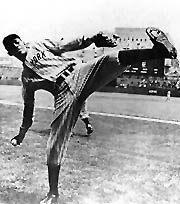 Satchel Paige, credited with 55 no-hitters, was the first Negro League star to be inducted into the Baseball Hall of Fame in Cooperstown. |
Satchel Paige, ace of the Crawfords, was perhaps the most colorful player of the era. Brimming with confidence, he used to send his entire infield into the dugout when the opposing team's best hitter stepped to the plate. He reportedly played over 2,000 games in the '20s and '30s.
Cool Papa Bell is one of the most dangerous hitters and undoubtedly the fastest base runner the Negro Leagues had ever seen. His speed lent itself to unending "fish" stories, most notably one that had Bell hitting a ground ball up the middle that hit him while sliding into second.
Jackie Robinson
Robinson wasn't the most talented player in the Negro Leagues, but Rickey considered him the most "suitable" player to desegregate baseball. The fact that he was married —and wouldn't give white ballplayers the impression that he would pursue their girlfriends— and his time in the Army and in school made him the top choice.
Over 20,000 fans filed into Comiskey Park to watch the Negro National League All-Star Game in 1933. By 1937, a sister league, the Negro American League, was formed. Thanks to the respect and popularity of these players and many like them, the leagues prospered in the '30s and well into the 1940s, when the color barrier was finally broken.Jackie Robinson had already spent time in the U.S. Army and been a four-sport star at UCLA when Branch Rickey, owner of the Major League's Brooklyn Dodgers, spotted him playing with the Kansas City Monarchs. Robinson wasn't the most talented player the Negro Leagues had to offer, but Rickey considered him the most "suitable" player to desegregate baseball. The fact that he was married (and therefore wouldn't give white ballplayers the impression that he would pursue their white girlfriends) and his time spent interacting with whites in the Army and in school made him Rickey's top choice. When he signed him to a minor league contract in 1945, Rickey told Robinson he was "looking for a ballplayer with guts enough not to fight back." He imposed a two-year commitment to silence, which Robinson grudgingly agreed to.
He played one season in the minors with the Montreal Royals and led the team to a league championship while leading the league in batting. The racial taunts were endless, but he stayed silent. On April 15, 1947, despite a petition by several of his teammates refusing to play, Jackie Robinson made his major league debut.
He played the entire season for the Dodgers, leading the league in steals and winning the Rookie of the Year award. Three months later, Larry Doby became the first black player in the American League when he was signed by the Cleveland Indians. Paige was signed by the Indians in 1948, becoming the oldest rookie ever. He only had twenty more years of playing left in him. Robinson won the league MVP in 1949 and teammate Roy Campanella, the Majors' first black catcher, later won it three more times. Some were still hesitant and racial threats persisted, but for all intents and purposes, the barrier was broken.
Today
Baseball has come a long way in the last fifty years towards recognizing the thousands of black players that lost opportunities. In 1997, as part of the 50th anniversary of the integration, Robinson's No. 42 was retired by every major league team. Currently 16 Negro League players are members of the National Baseball Hall of Fame, and the Negro Leagues now have their own museum in Kansas City. But as Paige said himself, "There were many Satchels, many Josh's." Hank Aaron is the all-time home run king, Willie Mays dazzled in the 50's and 60's, and black players such as Ken Griffey, Jr., Barry Bonds and Mo Vaughn are some of the top players in baseball today. We'd be naive to think the same couldn't have been true in the 1920s, '30s and '40s.


